Cyberattacks can affect many parts of an organization.
For example, an attack may start with a phishing email. It may then compromise a user account. After that, the attacker may access a laptop, server, or cloud system.
Therefore, organizations need strong security visibility.
Two technologies that can help are EDR and XDR.
Both technologies support threat detection and incident response. However, they do not provide the same level of visibility.
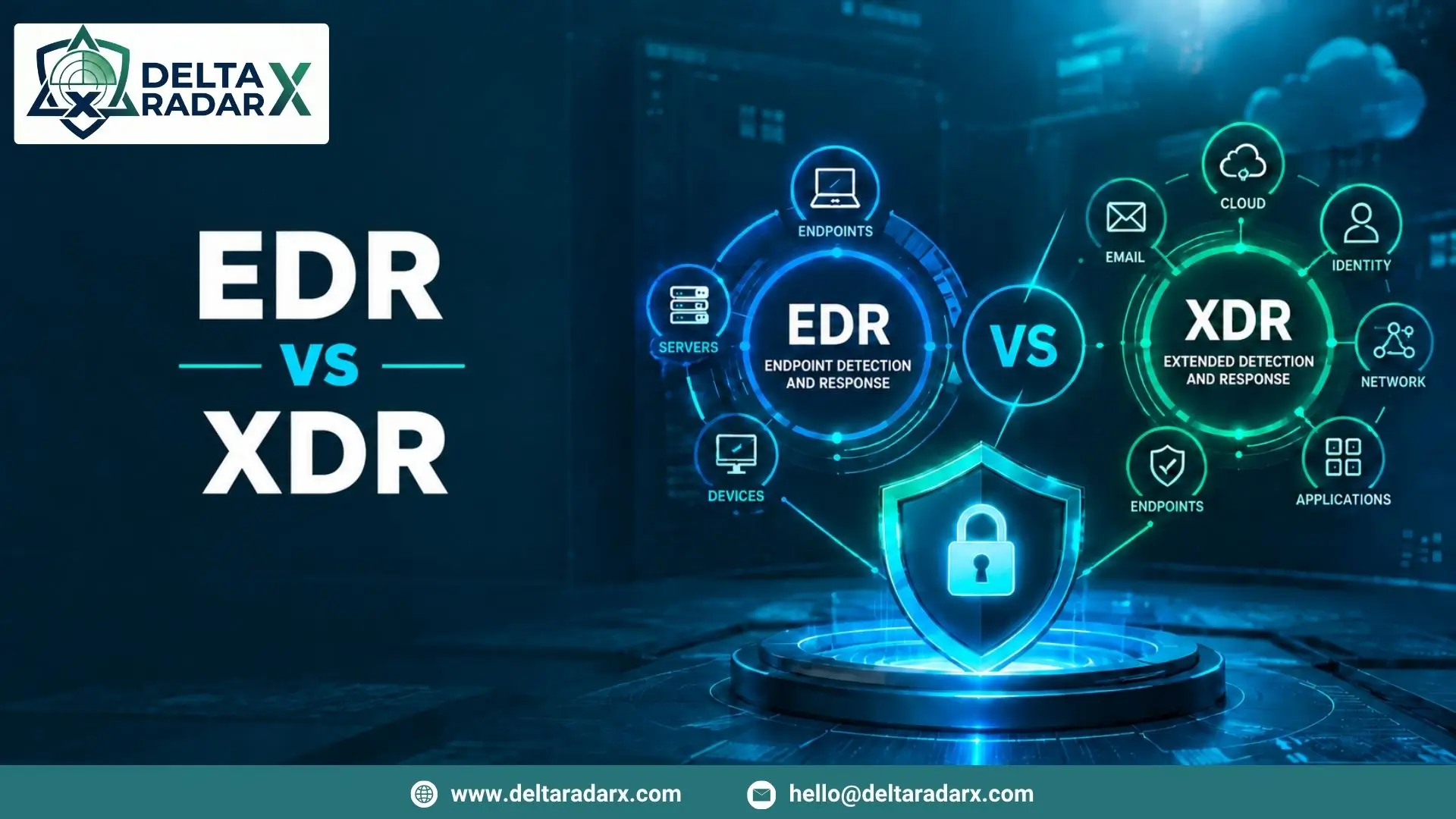
The main difference in the EDR vs XDR comparison is simple. EDR focuses on endpoints. XDR extends security monitoring across several parts of the IT environment.
This guide explains how both technologies work. It also covers their differences, benefits, limitations, and common use cases.
What Is EDR?
EDR stands for Endpoint Detection and Response.
It is a security technology that monitors endpoints for suspicious activity.
An endpoint can be:
- A laptop
- A desktop computer
- A workstation
- A server
- Another connected device
EDR continuously collects security information from these devices.
It then analyzes the activity for possible threats.
For example, an EDR platform may monitor processes, files, network connections, and user actions.
When it detects suspicious behavior, it can create an alert.
Security analysts can then investigate the affected device.
What Does EDR Monitor?
EDR provides detailed visibility into endpoint activity.
Depending on the platform, it may monitor:
- Running processes
- File changes
- Command execution
- Network connections
- User activity
- Registry changes
- Application behavior
- Suspicious scripts
This information can help security teams understand what is happening on a device.
As a result, they can investigate suspicious activity more effectively.
How Does EDR Work?
EDR usually works through an agent installed on an endpoint.
The agent monitors activity and sends security information to a centralized platform.
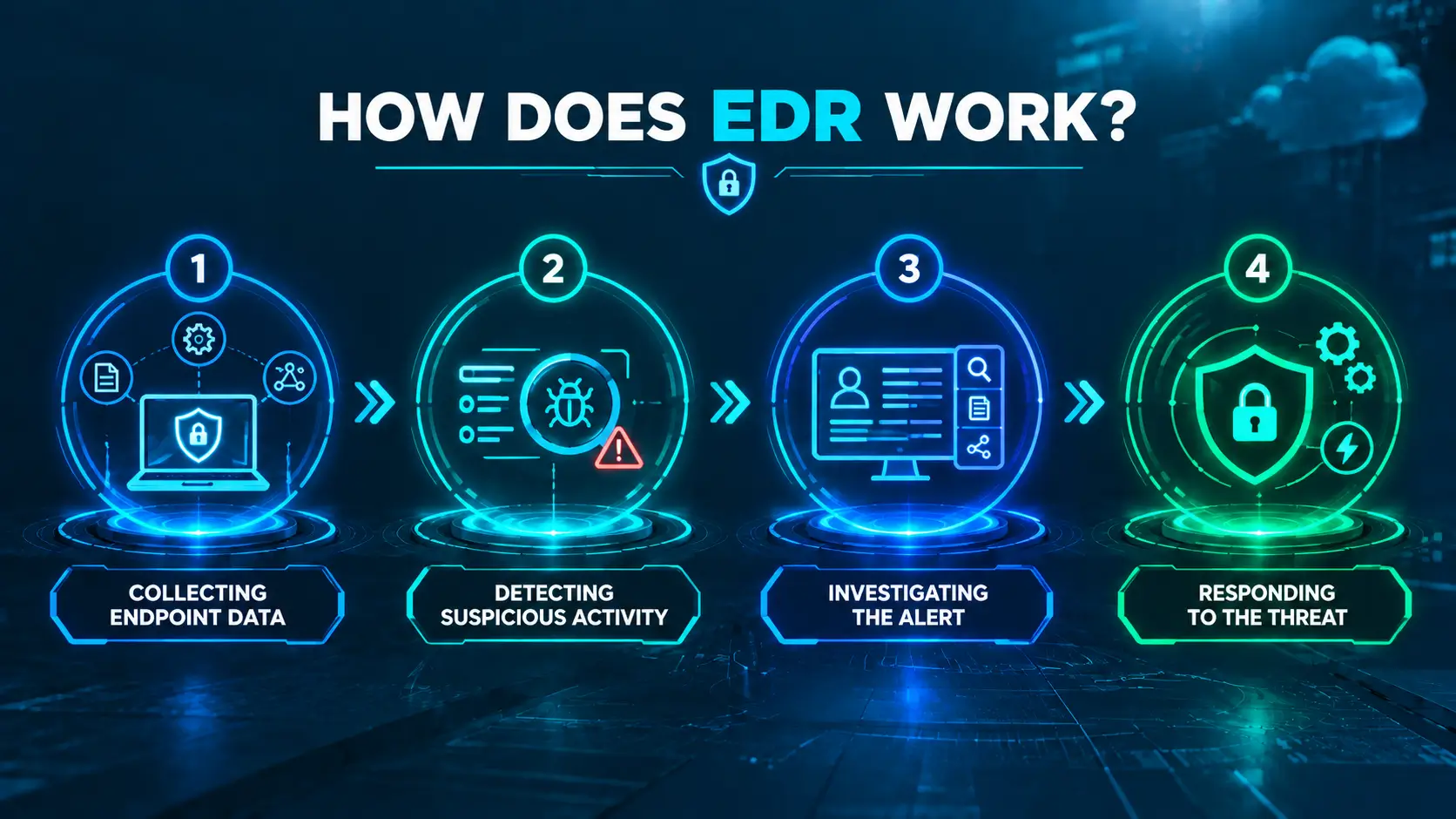
The process generally involves four steps.
Collecting Endpoint Data
First, the EDR agent collects information from the device.
For example, it can record which processes are running and which files are being accessed.
It can also monitor network connections.
This information creates a detailed record of endpoint activity.
Detecting Suspicious Activity
Next, the EDR platform analyzes the collected data.
It can use several detection methods, including:
- Security rules
- Known threat indicators
- Behavioral analysis
- Threat intelligence
- Machine learning
For instance, an unknown process may attempt to access sensitive files.
The EDR platform can identify this activity and generate an alert.
Investigating the Alert
Security analysts can then investigate the event.
They may review:
- The affected device
- The user involved
- The suspicious process
- Related files
- Network connections
- Commands executed
This information helps analysts understand what happened.
Responding to the Threat
If the activity is confirmed as malicious, the security team can take action.
For example, they may:
- Isolate the device
- Stop a malicious process
- Remove harmful files
- Block suspicious activity
- Collect forensic information
The available actions depend on the EDR platform.
What Is XDR?
XDR stands for Extended Detection and Response.
XDR takes threat detection beyond the endpoint.
Instead of focusing only on devices, XDR can collect and connect information from several security layers.
These may include:
- Endpoints
- Networks
- Email systems
- Identity platforms
- Cloud environments
- Applications
- Security tools
The goal is to provide a broader view of security activity.
For example, a single cyberattack may involve a suspicious email, a compromised account, malicious endpoint activity, and unusual network traffic.
Viewed separately, these events may appear unrelated.
XDR can help connect them.
Therefore, security analysts can see the wider context of a potential attack.
How Does XDR Work?
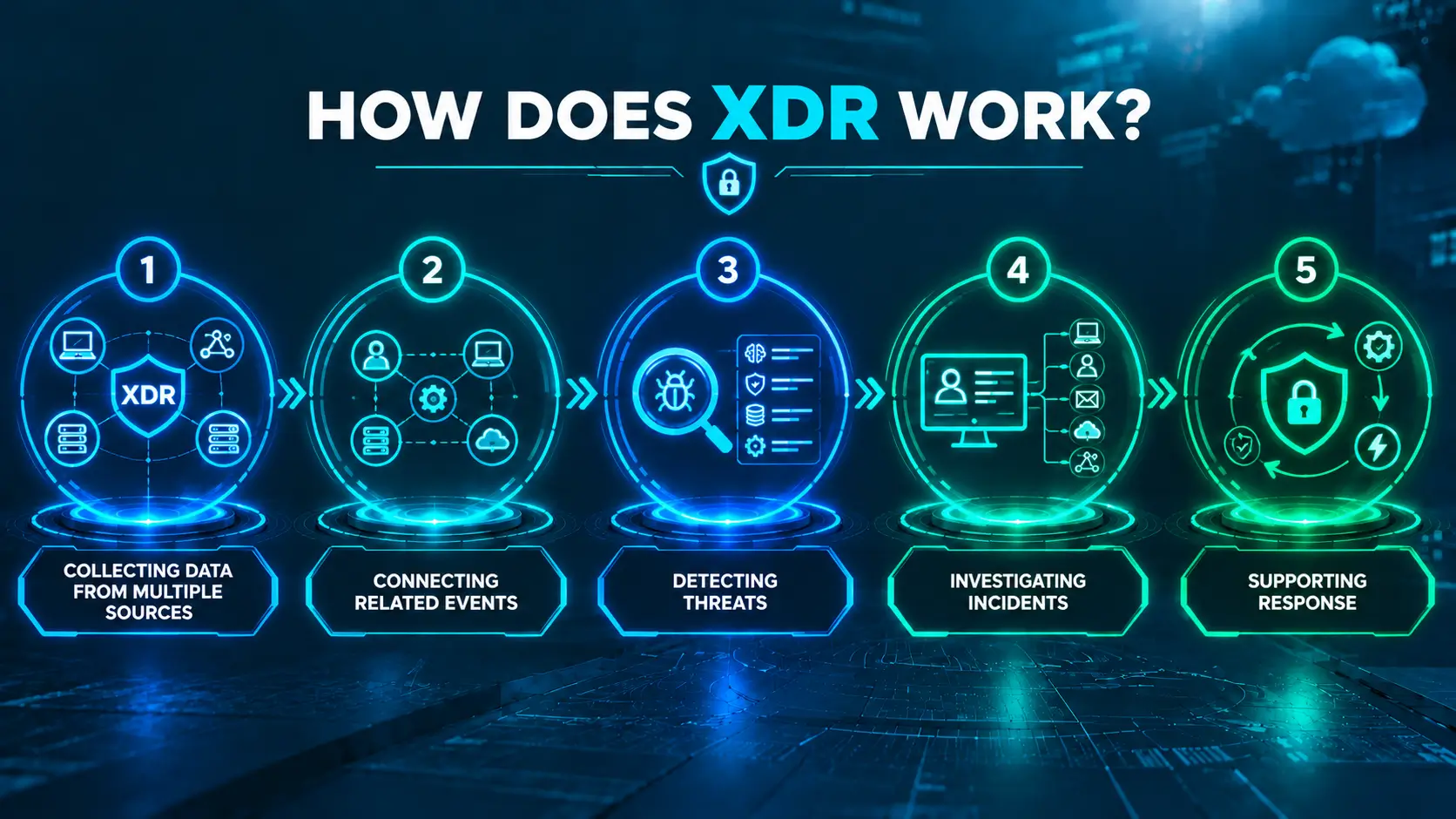
XDR collects information from connected security technologies.
It then analyzes events to identify suspicious relationships and attack patterns.
Collecting Data From Multiple Sources
XDR can receive security data from different parts of the environment.
For example, it may collect information from endpoints, identity systems, networks, and cloud platforms.
This broader visibility can improve threat investigations.
However, the exact coverage depends on the integrations supported by the XDR platform.
Connecting Related Events
Attackers often perform several actions during an attack.
For example, they may:
- Compromise a user account.
- Access a device.
- Run a suspicious process.
- Connect to another system.
- Attempt to access sensitive information.
Each event may look separate at first.
However, XDR can connect the related activity.
As a result, security teams can better understand the possible attack path.
Detecting Threats
XDR can use different detection methods.
These may include:
- Behavioral analysis
- Threat intelligence
- Security analytics
- Detection rules
- Machine learning
The purpose is to identify suspicious activity across more than one security layer.
Therefore, XDR can provide additional context for complex threats.
Investigating Incidents
XDR can bring related security events together.
For example, an analyst may see:
- Suspicious endpoint activity
- Unusual user logins
- Network connections
- Email events
- Cloud activity
This can make investigations easier.
Instead of reviewing every security tool separately, analysts may have more information in one investigation.
Supporting Response
Some XDR platforms also support response actions.
For example, a security team may isolate an endpoint or block suspicious activity.
However, the available response options depend on the platform and its integrations.
EDR vs XDR: The Main Difference
The biggest difference between EDR and XDR is their scope.
EDR mainly focuses on endpoints.
XDR provides broader visibility across multiple security layers.
| Feature | EDR | XDR |
|---|---|---|
| Main focus | Endpoint detection and response | Extended detection and response |
| Main data source | Endpoints and servers | Multiple security sources |
| Visibility | Devices | Multiple security layers |
| Threat detection | Endpoint-focused | Cross-layer detection |
| Investigation | Endpoint activity | Connected security activity |
| Response | Endpoint response | Broader response capabilities |
| Incident context | Device-level context | Wider incident context |
Both technologies are useful.
However, they solve different security challenges.
EDR vs XDR for Threat Detection
EDR is designed to detect suspicious activity on endpoints.
This is important because devices and servers are common attack targets.
EDR can help identify:
- Malware
- Ransomware activity
- Suspicious processes
- Malicious scripts
- Fileless attacks
- Unauthorized activity
- Credential-related threats
However, an attack does not always begin on an endpoint.
For example, an attacker may first compromise an identity account.
Alternatively, they may send a phishing email.
The endpoint may only be one part of the attack.
XDR provides a wider view.
It can connect information from different security layers.
Therefore, XDR may provide better context for complex attacks.
EDR vs XDR for Endpoint Security
EDR provides detailed information about individual devices.
This makes it particularly useful for endpoint security.
For example, security analysts can investigate what happened on a compromised laptop or server.
They can review:
- Process activity
- File changes
- User actions
- Commands
- Network connections
This detailed visibility can support endpoint investigations.
Organizations can also strengthen their device monitoring with Endpoint Threat Detection to identify and investigate suspicious activity across laptops, workstations, and servers.
XDR also uses endpoint data.
However, it combines that information with data from other security sources.
Therefore, XDR provides a broader perspective.
EDR vs XDR for Incident Investigation
Incident investigation requires context.
Security teams need to understand how an incident started and what happened next.
EDR provides detailed information about endpoint activity.
For example, it can show a suspicious process and its related activity.
This may include:
- Parent processes
- Files
- Commands
- User activity
- Network connections
XDR provides additional information.
For example, it can connect an endpoint event with:
- A suspicious email
- An unusual login
- Network activity
- Cloud activity
As a result, analysts can investigate the broader attack.
EDR vs XDR for Incident Response
EDR provides strong response capabilities for endpoints.
For example, a security team may isolate a compromised device.
This can help stop an attack from spreading.
Other actions may include stopping malicious processes.
XDR can support response across connected security technologies.
For example, a security investigation may involve:
- Isolating an endpoint
- Investigating a user account
- Reviewing network activity
- Checking cloud access
- Identifying related systems
Therefore, XDR can support a wider response process.
Still, the available features depend on the platform.
When Should You Choose EDR?
EDR may be the right choice when endpoint security is the main priority.
It can be useful for organizations that need better visibility into devices and servers.
Consider EDR when you need:
- Endpoint monitoring
- Malware detection
- Device isolation
- Process-level visibility
- Endpoint investigations
- Threat hunting on devices
EDR can provide an important security layer.
However, it does not always provide complete visibility across the organization.
When Should You Choose XDR?
XDR may be more suitable when broader visibility is required.
It can connect information from multiple security technologies.
Consider XDR when you need:
- Cross-layer threat detection
- Connected investigations
- Identity visibility
- Network monitoring context
- Cloud security visibility
- Email security context
- Broader incident information
XDR can be useful for complex security environments.
However, organizations should check which data sources the platform supports.
Integration options can affect the level of security visibility.
Can XDR Replace EDR?
In some cases, XDR includes endpoint detection capabilities.
However, XDR does not automatically replace every dedicated EDR solution.
Many XDR platforms rely on endpoint security technologies to collect important data.
Endpoint visibility is still essential.
For this reason, strong endpoint monitoring remains an important part of an XDR strategy.
Organizations should compare the capabilities of the specific platforms they are considering.
Can EDR Replace XDR?
EDR provides detailed endpoint visibility.
However, its focus is mainly on devices and servers.
It may not provide the same visibility into:
- Identity systems
- Email platforms
- Network activity
- Cloud environments
For example, EDR may detect a malicious process.
However, the attack may have started with a phishing email or compromised account.
XDR can help connect these events.
Therefore, EDR does not always replace the broader visibility provided by XDR.
Can EDR and XDR Work Together?
Yes.
EDR and XDR can complement each other.
EDR provides detailed information from endpoints.
XDR can combine this information with data from other security layers.
For example, EDR may detect suspicious activity on a server.
XDR can help determine whether that activity is related to:
- Suspicious logins
- Network traffic
- Email activity
- Cloud events
- Other endpoints
This additional context can improve investigations.
As a result, security teams can better understand the scope of an incident.
EDR vs XDR and SIEM
SIEM is another important technology used in security operations.
SIEM stands for Security Information and Event Management.
A SIEM platform collects logs from multiple systems.
These systems may include:
- Firewalls
- Servers
- Endpoints
- Applications
- Network devices
- Cloud platforms
- Identity systems
EDR focuses on endpoints.
XDR focuses on extended threat detection and response.
SIEM focuses on collecting, centralizing, and analyzing security events.
Organizations can use SIEM Integration to connect security data sources and create better centralized visibility.
In many environments, SIEM, EDR, and XDR can work together.
Each technology can provide a different type of security value.
EDR vs XDR for Security Operations
Security Operations Centers need continuous visibility.
Security teams must detect, investigate, and respond to potential threats.
EDR can provide detailed endpoint information.
XDR can provide connected visibility across multiple security technologies.
These capabilities can support:
- Continuous monitoring
- Alert investigations
- Threat detection
- Incident analysis
- Threat hunting
- Response activities
However, technology alone is not enough.
Security alerts still require investigation.
Experienced analysts are important because suspicious activity does not always mean a confirmed attack.
EDR vs XDR for Threat Hunting
Threat hunting is a proactive security practice.
Instead of waiting for an alert, analysts actively search for suspicious behavior.
EDR provides detailed endpoint telemetry.
For example, threat hunters can investigate:
- Unusual processes
- Suspicious commands
- File activity
- Network connections
- User behavior
XDR provides broader information.
It can connect endpoint activity with identity, network, email, and cloud events.
Therefore, XDR can help threat hunters investigate activity across multiple environments.
Benefits of EDR
EDR provides several important benefits.
Detailed Endpoint Visibility
EDR collects information directly from devices.
As a result, security teams can investigate endpoint activity in detail.
Faster Endpoint Investigation
Security analysts can review processes, files, users, and connections.
This can make investigations faster.
Endpoint Response
EDR can help security teams isolate compromised devices.
It may also support other response actions.
Ransomware Detection
EDR can identify suspicious behavior associated with ransomware.
This can help security teams investigate the activity quickly.
Support for Threat Hunting
Endpoint data can help analysts search for suspicious behavior proactively.
Benefits of XDR
XDR also provides several important benefits.
Broader Threat Visibility
XDR can connect data from multiple security layers.
This can provide a broader view of potential threats.
Better Incident Context
Related events can be investigated together.
Therefore, analysts may better understand how an incident developed.
Faster Investigation
Security teams may spend less time moving between different tools.
Connected Detection
XDR can identify suspicious patterns across multiple environments.
This can help detect more complex attacks.
Improved Response Coordination
Connected information can help security teams coordinate their response.
Challenges of EDR
EDR also has limitations.
Limited Visibility Beyond Endpoints
EDR mainly focuses on devices and servers.
Therefore, it may not provide complete visibility into cloud, identity, or email systems.
Alert Volume
Large organizations can generate many endpoint alerts.
Security teams need effective processes to prioritize them.
Skilled Analysts Are Required
EDR alerts still require investigation.
A suspicious event is not always a confirmed threat.
Challenges of XDR
XDR also has challenges.
Integration Requirements
XDR depends on connected data sources.
Limited integrations can reduce visibility.
Platform Compatibility
Some XDR platforms work best with technologies from the same vendor.
Therefore, organizations should review compatibility before selecting a solution.
Implementation Complexity
Connecting multiple security technologies can require planning.
It may also require technical expertise.
Data Quality
Detection quality depends on the data available to the platform.
Incomplete data can create security blind spots.
How to Choose Between EDR and XDR
The right choice depends on your security requirements.
Choose EDR when your main priority is:
- Endpoint protection
- Device monitoring
- Malware detection
- Endpoint investigation
- Device isolation
Choose XDR when your main priority is:
- Broader threat visibility
- Cross-layer detection
- Connected investigations
- Identity monitoring
- Cloud visibility
- Coordinated response
Some organizations may need both.
Therefore, review your infrastructure before choosing a solution.
EDR vs XDR at DeltaRadarX
Security technology is only one part of an effective cybersecurity strategy.
Organizations also need continuous monitoring and skilled investigation.
DeltaRadarX supports security operations with 24/7 SOC monitoring, SIEM and log monitoring, MDR, EDR, incident response, threat intelligence, SOAR automation, firewall monitoring, network monitoring, vulnerability auditing, and compliance reporting.
For example, suspicious endpoint activity can be investigated alongside firewall logs and network events.
This can provide more context during an investigation.
As a result, security analysts can make better decisions about potential threats.
Organizations that need continuous security support can use Managed Detection and Response Services for threat detection, investigation, threat hunting, and incident response.
DeltaRadarX also provides co-managed SOC support for organizations with internal IT or security teams.
This can provide additional security expertise and monitoring capacity.
Final Thoughts
The EDR vs XDR comparison is mainly about security scope.
EDR focuses on endpoints.
XDR extends detection and response across multiple security layers.
EDR can be a strong choice for organizations that need detailed endpoint visibility.
XDR can be useful for organizations that need broader security context.
Neither technology is automatically better for every organization.
The right choice depends on your environment and security requirements.
In some cases, EDR and XDR can work together.
When combined with centralized monitoring, skilled analysts, and a clear incident response process, these technologies can help organizations detect and respond to cyber threats more effectively.